
Since its inception by Dr. John R. Adler at Stanford University in 1991, the CyberKnife® System (Accuray Inc.) has redefined non-invasive stereotactic radiosurgery (SRS) and stereotactic body radiation therapy (SBRT). By fusing a lightweight 6 MV linear accelerator (LINAC) with a flexible, multi-articulated industrial robotic arm and continuous X-ray motion-tracking image guidance, CyberKnife eliminated the historic reliance on rigid metal head frames and rigid body immobilization.
Across successive technological generations, CyberKnife has continuously addressed key challenges in radiation delivery: treatment speed, field shaping, real-time internal motion tracking, and automated target optimization.
Evolution of CyberKnife Versions & Breakthrough Launch Features
1. Prototype & Early Clinical Systems (1991 – 2001)
- Launch Milestone: Installed at Stanford University in 1991. Achieved FDA clearance for intracranial tumors in 1999 and full-body clearance in 2001.
- Uniqueness at Launch:
- Replaced static, gantry-based delivery with a 6-axis robotic arm.
- Replaced rigid invasive head frames with frameless, image-guided patient tracking using anatomical bone landmarks.
- Primary Focus: Proving sub-millimeter radiosurgical accuracy for intracranial and early spinal targets without fixed stereotactic head frames.
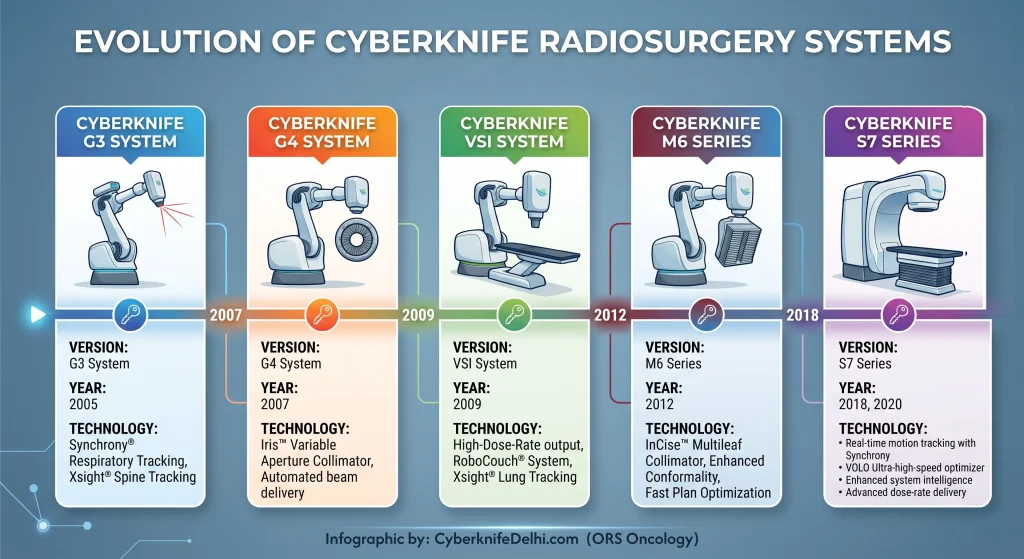
2. CyberKnife G3 System (2005)
- Uniqueness at Launch: Introduced mature Synchrony® Real-Time Respiratory Tracking Technology and Xsight® Spine Tracking System.
- Key Innovations:
- Synchrony®: Matched internal tumor movement caused by breathing (e.g., in lung, liver, or pancreas) with continuous robotic motion adjustment in real time.
- Xsight® Spine: Tracked skeletal anatomy directly without requiring invasive surgical fiducial markers for spinal lesions.
- Impact: Shifted radiosurgery from an intracranial-only procedure to a reliable, body-wide ablative treatment modality (SBRT).
3. CyberKnife G4 System (2007)
- Uniqueness at Launch: Re-engineered industrial robotic architecture and introduced the dynamic Iris™ Variable Aperture Collimator.
- Key Innovations:
- Iris™ Collimator: Automatically altered circular beam diameters (ranging from $5\text{ mm}$ to $60\text{ mm}$) during a delivery session without requiring manual physical collimator cone changes.
- Upgraded image-processing hardware, reducing image acquisition and processing cycles significantly.
- Impact: Reduced overall beam-delivery time and improved conformity for irregularly shaped target volumes.
4. CyberKnife VSI (Volume Spectrum Irradiation) System (2009)
- Uniqueness at Launch: Integration of Intensity-Modulated Radiotherapy (IMRT) capabilities alongside classic SRS/SBRT, combined with high-dose-rate output ($1000\text{ MU/min}$).
- Key Innovations:
- RoboCouch® System: Added a 6-degree-of-freedom robotic couch capable of automated sub-millimeter translational and rotational patient position corrections.
- Xsight® Lung Tracking: Allowed tracking of soft-tissue lung tumors directly without requiring fiducial implantation in selected clinical cases.
- Impact: Allowed centers to perform both traditional ultra-precise radiosurgery and conventional fractionated radiation, expanding high-throughput clinical capacity.
5. CyberKnife M6 Series (2012)
- Uniqueness at Launch: Introduction of the InCise™ Multileaf Collimator (MLC), specifically engineered for a robotic delivery platform.
- Key Innovations:
- InCise™ MLC: Allowed fast, automated shaping of non-circular radiation fields using high-precision tungsten leaves.
- Advanced optimization algorithms capable of treating larger or multi-focal target volumes (such as multiple brain metastases or large prostate glands) efficiently.
- Impact: Reduced typical treatment fraction times from 60 minutes down to 15–30 minutes, making SBRT and SRS far more practical and comfortable for patients.
6. CyberKnife S7 System (2020 – Present)
- Uniqueness at Launch: Integration of VOLO™ Optimizer powered by artificial intelligence and Synchrony® AI-driven real-time tracking.
- Key Innovations:
- VOLO™ Optimization Engine: Reduced treatment planning calculation times from hours to minutes while simultaneously finding optimal robotic paths to shave up to 50% off beam delivery times.
- Full-Spectrum Synchrony®: Real-time tracking and continuous movement correction across all treatment targets (respiratory, cardiac, spinal, and brain targets) utilizing dynamic AI motion estimation models.
- Interoperability: Direct integration into modern enterprise Oncology Information Systems (OIS) such as ARIA®, MOSAIQ®, and RayCare®.
- Impact: Enabled full sub-millimeter, motion-synchronized stereotactic treatments to be routinely delivered within conventional 15-minute time slots.
Detailed Model Feature Comparison
| Feature / Capability | G3 / G4 Series | VSI Series | M6 Series | S7 Series |
| Primary Launch Era | 2005 – 2007 | 2009 | 2012 | 2020+ |
| Max Dose Rate | $600–800\text{ MU/min}$ | $1000\text{ MU/min}$ | $1000\text{ MU/min}$ | $1000\text{ MU/min}$ |
| Collimation Tech | Fixed Cones / Iris™ | Iris™ Collimator | InCise™ MLC + Iris™ | InCise™ MLC + Iris™ |
| Patient Positioning | Axum / Standard Couch | RoboCouch® (6-DOF) | RoboCouch® (6-DOF) | RoboCouch® (6-DOF) |
| Planning Engine | MultiPlan® V2–V3 | MultiPlan® V4 | MultiPlan® V5 / Precision® | VOLO™ Optimizer / Precision® |
| Avg. Session Duration | 45 – 90 minutes | 30 – 60 minutes | 20 – 40 minutes | 15 – 20 minutes |
1. Superior Motion Adaptation vs. Conventional C-Arm LINACs (Varian / Elekta)
- The Problem with Standard LINACs: Standard gantry-based linear accelerators rely on “gating” (turning the beam off when the tumor moves out of a box) or wide Internal Target Volumes (ITV) adding 10–15mm safety margins. This exposes large volumes of healthy tissue to radiation.
- The CyberKnife Advantage: Using real-time continuous image guidance and the robotic arm, CyberKnife follows the tumor continuously while the beam is ON. Safety margins are reduced to $1–2\text{ mm}$, significantly mitigating acute and chronic toxicity.
2. Non-Invasive Flexibility vs. Gamma Knife®
- The Problem with Gamma Knife: Gamma Knife requires a rigid metal frame to be bolted directly into the patient’s skull bone under local anesthesia. It is also limited almost exclusively to intracranial indications.
- The CyberKnife Advantage: CyberKnife is completely frameless. It uses non-invasive mesh masks for brain treatments and can perform hypofractionated radiosurgery (3–5 sessions), which is much safer for large brain lesions or targets located adjacent to critical structures like the optic nerve or brainstem. Additionally, CyberKnife treats the entire body (lung, spine, liver, prostate, pancreas).
3. Non-Isocentric Beam Delivery
- Traditional Radiotherapy: Delivers beams that intersect at a single central point (isocenter), making it difficult to conform to complex, non-spherical, or elongated tumors without irradiating adjacent normal structures.
- CyberKnife: Features non-isocentric, non-coplanar beam delivery. The robotic arm can deliver hundreds of unique beam angles targeted precisely at irregular geometry, yielding ultra-sharp dose fall-off at target boundaries.
Summary
The evolution of CyberKnife from early frame-free brain radiosurgery (1990s) to the AI-driven, MLC-equipped CyberKnife S7 (2020s) represents a major leap in stereotactic therapy. By combining sub-millimeter precision, active motion tracking without rigid restraint, and rapid robotic delivery, modern CyberKnife platforms continue to set the standard for patient safety, speed, and clinical efficacy.