
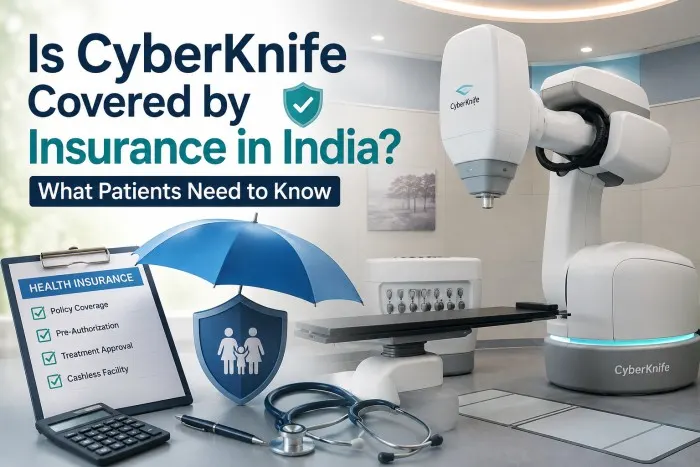
CyberKnife robotic radiosurgery has transformed cancer care in India by offering a non-invasive, highly precise alternative to traditional surgery and conventional radiation. It delivers focused high-dose radiation beams with sub-millimeter accuracy to treat tumors in the brain, prostate, lung, spine, pancreas, liver, and other sites—often in just 1–5 outpatient sessions with minimal impact on healthy tissue.
A common question from patients and families is: Does health insurance cover CyberKnife treatment in India? The short answer is yes in many cases, but coverage is not automatic or uniform. It depends on your specific policy, the insurer’s terms, medical necessity, pre-authorization, and whether the treating hospital is empanelled. Here’s a clear, practical guide to what patients need to know.
IRDAI Mandate: Stereotactic Radiosurgery Must Be Covered
In 2019, the Insurance Regulatory and Development Authority of India (IRDAI) issued guidelines requiring health insurers to cover 12 modern treatments when medically indicated. One of these is stereotactic radiosurgery (also called stereotactic radio surgeries). CyberKnife is a leading form of stereotactic radiosurgery/stereotactic body radiation therapy (SBRT), so it falls under this mandate.
This means insurers cannot permanently exclude CyberKnife simply because it is an advanced technology. Coverage applies to both inpatient and day-care procedures, subject to the policy’s overall terms, sum insured, waiting periods, and any sub-limits.
Important caveat: While coverage is mandatory in principle, many policies (especially older or budget ones) impose sub-limits on modern treatments. For example, a ₹10 lakh policy might restrict robotic or stereotactic procedures to ₹1–2 lakh or a percentage of the sum insured. Newer comprehensive plans from leading insurers often cover modern treatments up to the full sum insured. Always check the fine print or ask for a written confirmation.
What Affects CyberKnife Insurance Coverage?
Several factors determine how much (if anything) your insurer will pay:
- Medical necessity and documentation — The treatment must be recommended by a qualified radiation oncologist or multidisciplinary team as appropriate for your condition. Detailed medical records, imaging (MRI/CT/PET), and a justification letter from the treating doctor are essential.
- Policy type and sum insured — Indemnity-based health insurance (hospitalization cover) is the primary vehicle. Critical illness or cancer-specific riders may provide additional support as a lump sum.
- Sub-limits and exclusions — Look for any caps on “modern treatments,” “radiosurgery,” or “advanced radiation therapy.” Day-care procedures are usually covered, but some older policies may still treat advanced radiation differently.
- Hospital empanelment — Cashless treatment is available only at network hospitals. Reimbursement claims are possible at non-network centers but involve more paperwork and possible delays.
- Pre-authorization — Most insurers require prior approval before treatment begins. Starting this process early prevents claim rejections or partial payments.
- Waiting periods — Standard waiting periods for pre-existing conditions or specific diseases (often 2–4 years for cancer-related treatments in some policies) still apply unless waived.
- Government schemes — Ayushman Bharat (PM-JAY) covers radiation therapy and cancer treatments up to ₹5 lakh per family per year at empanelled hospitals. Advanced modalities like CyberKnife may be available under package rates at select centers (availability is limited and varies by state/hospital). CGHS and ECHS beneficiaries can often access treatment at approved rates in empanelled private or government facilities.
Typical Cost of CyberKnife in India and Out-of-Pocket Reality
CyberKnife treatment in India generally ranges from approximately ₹2.5 lakh to ₹8 lakh or more (sometimes higher for complex multi-session or multi-lesion cases), depending on the hospital, city, number of fractions, tumor complexity, and required planning/imaging. This is substantially lower than costs in the US or Europe.
Even with insurance:
- You may still face co-payments, deductibles, or amounts above any sub-limit.
- Pre- and post-treatment investigations, medications, and follow-ups may have separate coverage rules.
- International patients usually pay out-of-pocket or through their home-country insurance (if it covers overseas treatment).

Practical Steps to Maximize Coverage
- Review your policy document carefully — Search for “modern treatments,” “stereotactic,” “radiosurgery,” “robotic,” or the list of IRDAI-mandated procedures. Note any sub-limits.
- Contact your insurer early — Call the customer care or relationship manager and ask specifically: “Does my policy cover CyberKnife / stereotactic radiosurgery for [your condition]? What is the sub-limit (if any)? What documents are required for pre-authorization?”
- Obtain a detailed treatment plan — Ask your radiation oncologist for a formal letter explaining medical necessity, expected number of sessions, and why CyberKnife is preferred over conventional options.
- Seek pre-authorization — Submit the required documents (policy copy, medical reports, doctor’s recommendation, cost estimate) well before the planned treatment date. The hospital’s insurance desk can often assist.
- Choose an empanelled hospital — Confirm that the CyberKnife center is in your insurer’s network for cashless facility.
- Keep all records — Maintain copies of every submission, approval letter, bills, and discharge summary for reimbursement claims if needed.
- Explore alternatives if coverage is limited — Hospital payment plans, medical loans, crowdfunding platforms, or government schemes (Ayushman Bharat, state health schemes, CGHS/ECHS) can bridge gaps. Some centers also offer package discounts for self-paying patients.
Common Pitfalls to Avoid
- Assuming automatic full coverage without checking sub-limits.
- Delaying pre-authorization until after treatment has started.
- Choosing a non-network hospital without understanding reimbursement rules.
- Incomplete medical documentation that leads to claim queries or rejection.
- Overlooking waiting periods for pre-existing cancer or related conditions.
Bottom Line for Patients
CyberKnife is covered under the IRDAI’s modern treatments mandate as a form of stereotactic radiosurgery, giving patients a strong foundation for claims. However, the actual payout depends heavily on your individual policy wording, sub-limits, and procedural compliance. Proactive communication with both your insurer and the treating hospital is the single most effective way to reduce financial stress.
If you or a loved one is considering CyberKnife treatment in Delhi or other centers in India, the team at centers specializing in advanced radiosurgery can help review reports, provide a detailed cost estimate, and guide you through the insurance process. Many patients successfully receive partial or substantial coverage when they prepare thoroughly.
Need clarity on your specific case? Upload your medical reports for a free second opinion and personalized guidance on treatment options and insurance navigation. Early planning can make a significant difference in both clinical outcomes and financial peace of mind.