
Executive Summary & Clinical Paradigm Shift
Over my 15+ years in radiation oncology and stereotactic radiosurgery (SRS/SBRT), the emergence of sub-millimeter image-guided robotic radiosurgery (CyberKnife®) has transformed our treatment algorithms. Traditional External Beam Radiation Therapy (EBRT) often requires 30–40 fractions to deliver a radical dose while protecting adjacent healthy tissue. CyberKnife utilizes continuous real-time motion tracking (Synchrony® system) and non-isocentric robotic delivery to deliver ultra-hypofractionated, highly ablative doses in 1 to 5 sessions with sharp dose fall-off.
While conventional treatments (radical surgery, conventional EBRT, systemic chemotherapy) remain standard in various indications, CyberKnife achieves equivalent to superior local control with significantly reduced treatment durations and organ-at-risk (OAR) toxicity.
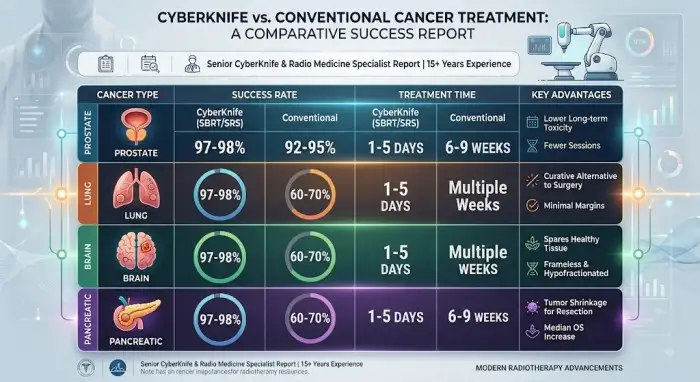
Comparative Matrix: CyberKnife vs. Standard Care
| Malignancy | CyberKnife (SBRT / SRS) Success Rate | Conventional Treatment Success Rate | Key Advantage of CyberKnife |
|---|---|---|---|
| Prostate Cancer (Low / Int-Risk) | 97–98% 5-yr Biochemical Free Survival; 93–98% 10-yr Local Control | 92–95% 5-yr Control (IMRT/Proton); 90–95% (Radical Prostatectomy) | 5 days vs. 8 weeks of IMRT; lower long-term GI/GU toxicity & sexual dysfunction. |
| Stage I Lung Cancer (NSCLC) | 88–95% 3-yr Local Control; 85–92% 2-yr Overall Survival | 85–90% 3-yr Local Control (Surgical Lobectomy); 60–70% (Conv. EBRT) | Non-invasive alternative for medically inoperable or frail patients. |
| Brain Metastases (1–4 lesions) | 85–92% 1-yr Local Control; preserving neurocognition | 80–85% Whole Brain Radiation (WBRT); 85–90% Surgical Resection | Spares healthy brain parenchyma; avoids WBRT-induced cognitive decline. |
| Pancreatic Cancer (Locally Advanced) | 75–85% 1-yr Local Control; Median OS 12–16 months | 50–65% 1-yr Local Control (Conv. Chemoradiation); Median OS 9–11 months | Achieves tumor shrinkage, margin clearing, and pain palliation without delaying systemic therapy. |
Detailed Oncology Subspecialty Analysis
1. Prostate Cancer (Low & Intermediate Risk)
CyberKnife SBRT Data
- Local Control & Survival: 10-year prospective data demonstrates a 98.4% local disease control and a 93.7% disease-free survival (DFS) rate. 5-year biochemical relapse-free survival (BRFS) stands at 97–100% for low-risk and 92–95% for intermediate-risk cohorts.
- Dose & Fractionation: Total dose of 36.25–37.5 Gy delivered in 5 fractions over 1–2 weeks.
Comparison with Standard Care
- Radical Prostatectomy (RP): Equivalent 5-year control rates (~92–95%). However, surgery carries a 15–30% risk of long-term urinary incontinence and 50–70% risk of erectile dysfunction.
- Conventional IMRT / Proton Therapy: Achieves 90–95% 5-year BRFS but requires 39 to 44 daily treatment visits over 8–9 weeks.
Expert Commentary: Because prostate tumors have a low $\alpha/\beta$ ratio ($\approx 1.5\text{ Gy}$), they respond exceptionally well to high-dose hypofractionated radiation. CyberKnife’s real-time motion tracking accounts for rectal gas and bladder filling, enabling tight 2mm margins that preserve sexual potency and urinary continence.
2. Early-Stage Non-Small Cell Lung Cancer (Stage I NSCLC)
CyberKnife SBRT Data
- Local Control: 2-year and 3-year local control rates range between 88% and 95%. 5-year local control remains 65–78% in high-risk/elderly cohorts.
- Overall Survival: 2-year OS ranges from 80% to 85% in operable and inoperable cohorts.
Comparison with Standard Care
- Surgical Resection (Lobectomy): Considered the traditional gold standard, yielding a 3-year local control rate of ~88–92%. However, morbidity in patients with COPD or cardiac comorbidities is substantial.
- Conventional Radiation (EBRT): 2-year local control is suboptimal at 50–65% due to lower total biologically effective doses (BED $< 100\text{ Gy}$).
Expert Commentary: The Synchrony® system tracks lung nodules in real time as the patient breathes, eliminating the need for uncomfortable breath-hold techniques or wide target volumes. For medically inoperable patients—or those declining surgery—CyberKnife offers curative-intent outcomes virtually equal to lobectomy.
3. Brain Tumors & Metastases
CyberKnife SRS Data
- Brain Metastases (1–4 Lesions): 1-year local tumor control rate is 85–92%.
- Benign Tumors (Acoustic Neuromas / Meningiomas): 5-year long-term control exceeds 90–95%, with hearing preservation rates up to 65–75%.
Comparison with Standard Care
- Whole Brain Radiation Therapy (WBRT): Historical standard for brain metastases, but causes significant neurocognitive decline, fatigue, and memory loss within 3–6 months.
- Neurosurgical Resection: Effective for large symptomatic mass-effect lesions ($> 3\text{ cm}$), but invasive, requiring craniotomy with potential surgical risks.
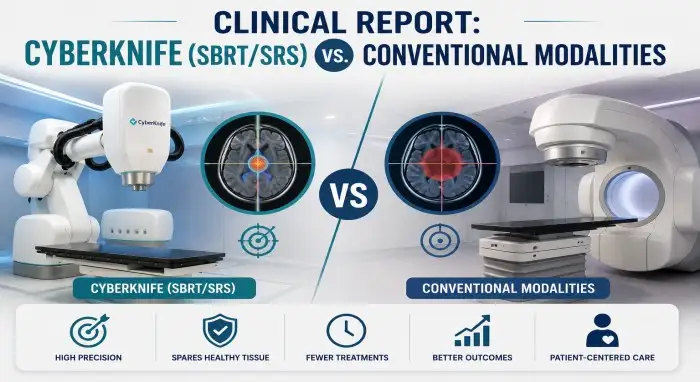
Expert Commentary: Unlike frame-based stereotactic systems (e.g., Gamma Knife) that require a rigid head frame screwed into the skull, CyberKnife uses frameless image guidance. It allows hypofractionated SRS (e.g., 3–5 fractions) for larger brain lesions near optic chiasm or brainstem where single-fraction radiation would carry high toxicity risks.
4. Pancreatic Cancer (Locally Advanced & Borderline Resectable)
CyberKnife SBRT Data
- Local Control: 1-year local control ranges from 75% to 85%.
- Overall Survival: Combined with systemic chemotherapy (FOLFIRINOX or Gemcitabine/Nab-Paclitaxel), median survival reaches 14–17 months, compared to 9–11 months with chemotherapy alone.
- Resection Conversion: Converts 15–25% of borderline/unresectable cases into surgically resectable ($R0$) candidates.
Comparison with Standard Care
- Conventional Chemoradiation (30 fractions): 1-year local control is lower (~50–60%), and long treatment delays hinder the delivery of full-dose systemic chemotherapy.
- Surgical Resection alone: Operable in only ~15–20% of presentation cases due to early vascular involvement (celiac artery / SMA).
Expert Commentary: Pancreatic tumors move dynamically with respiration and bowel peristalsis. CyberKnife delivers high ablative radiation doses in 5 sessions, achieving rapid local pain relief and tumor shrinkage while minimizing radiation enteritis or duodenal perforation.
Clinical Conclusions
Multimodal Synergy: Short treatment schedules allow CyberKnife to be seamlessly integrated before or after chemotherapy/immunotherapy without treatment gaps.
Patient Quality of Life: Reduces overall treatment duration from months/weeks down to 1–5 single-hour outpatient visits, accelerating recovery and minimizing disruption.
Precision & Safety: Sub-millimeter tracking dramatically limits radiation exposure to adjacent normal tissues (rectum, bladder, healthy lung, duodenum, brainstem).